


Design Build: The Ultimate Guide to Getting the Best Value for Your Custom Home Project
In this article we will give you an all-encompassing rundown of Design Build and why it provides the best value for Homeowners when approaching a custom home project. We will also cover the difference between Design Build and Design Bid Build, including pros and cons of each, and the two different types of Design Build firms.
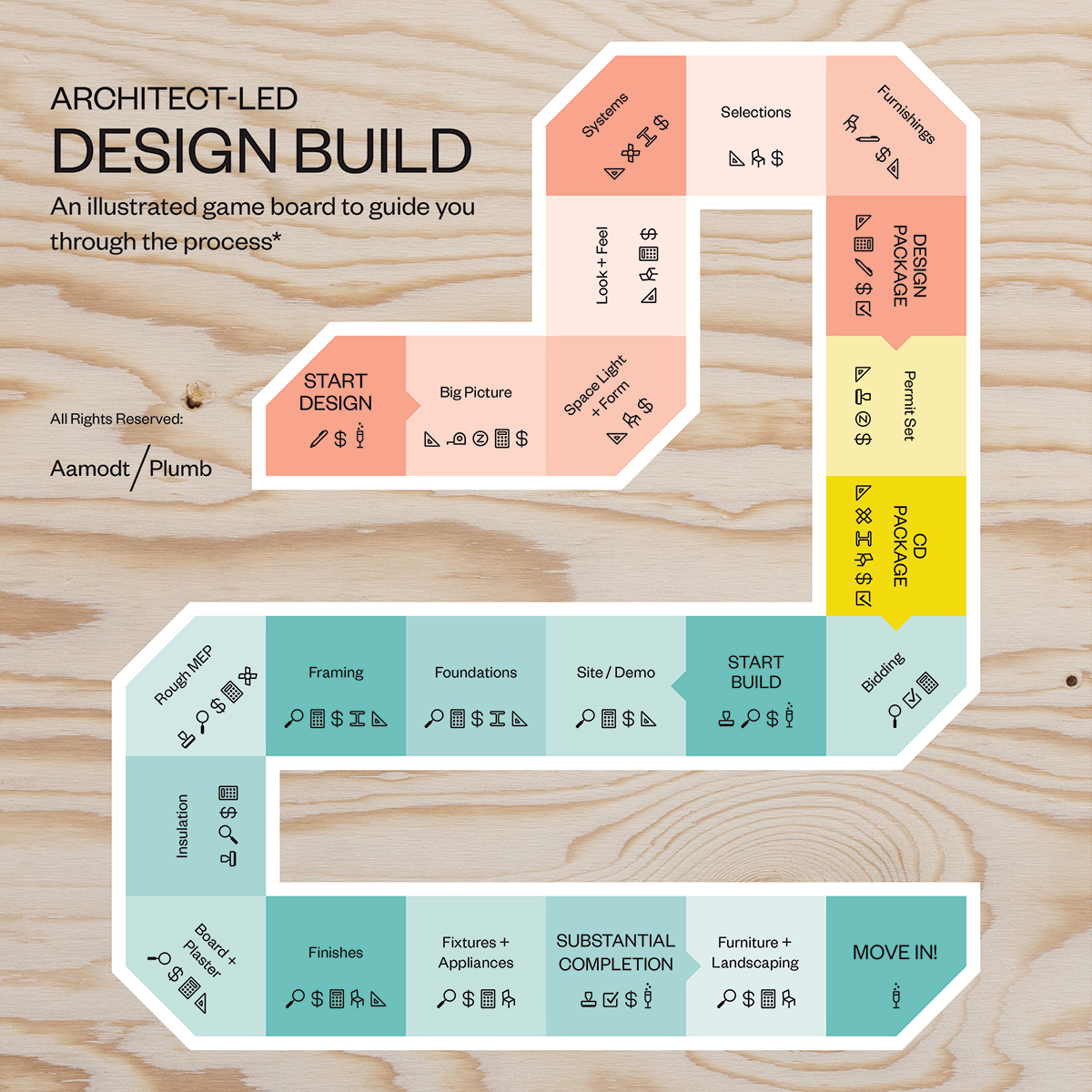
Featured Free Download
You can download all of this information in our Architect-Led Design Build game board.
Send Me The Guide1. What is Design Build and Why Does it Matter
Once upon a time, before email and airplanes, telephones and railways, the job of designing and building was the responsibility of one entity, not divided up between two or more like we find today. These days design is the responsibility of the Architect and construction is the responsibility of the Builder. The Owner ends up somewhere in the middle, having contracts with each of them. This is the way we at Aamodt / Plumb worked for more than a decade. It is what we were taught and what most Architects do. As we struggled to grow our business we found it was very difficult to work this way. The Owners, Builders and ourselves were often frustrated by communication problems, contractual roadblocks and inefficiency. In an effort to find a new way to practice we ended up rediscovering a very old way, ‘Design Build’.
Design Build is a project delivery method where the Owner hires a single entity to both design and construct their project, as opposed to hiring an Architect and Builder separately.
2. History of Design Build
For thousands of years Architects and Builders were one and the same. They were called Master Builders. In fact, the word ‘architect’ derives from the Greek ‘arkhi’ (chief) and ‘tekton’ (builder). Vitruvius, who lived around 50 BC, was a Roman Architect, which meant he designed buildings and did construction, engineering, landscape architecture and urban planning. Vitruvius was clearly a learned man and we know of him because of his enduring text “The Ten Books on Architecture,” however there was no formal education in architecture at the time. During the Renaissance Architects had a similarly broad role, sometimes including philosophy, painting and craftsmanship as well. In the 15th century Leonardo da Vinci was a self-taught Architect that learned by working as an apprentice in a painter’s studio. In fact, all Architect’s were self-taught or learned through apprenticeship, usually as masons, carpenters and artisans.
Making things with your hands was a valuable, respected skill up until the 1800’s when the Industrial Revolution increased the scale of production through machinery. Hundreds of thousands of people were now making things in low skill jobs that were associated with the grime and pollution of coal-fired factories and crowded cities. Architects of the time wanted to distance themselves from these dirty makers and hide in their ivory towers. Thus began the professionalization of Architects and the fissure between them and the Builders. This transition is beautifully illustrated in this video by Gluck+, an Architect Led Design Build firm in New York.
3. Understanding Where We Are Today: Design Bid Build
With two entities, the Architect and Builder, the typical sequence today is for the Architect to design the building and then help the owner bid it out to several Builders, ultimately choosing one to build the project. This process is called ‘Design Bid Build’. It evolved out of the split between Architects and Builders and maintains the clear distinctions and responsibilities of each party. The entire industry has evolved its legal and insurance practices around this model entrenching the chasm even further. The advantage most often touted is that competitive bidding will result in the lowest possible construction cost. Government projects are always run this way because they are required to accept the lowest bidder.
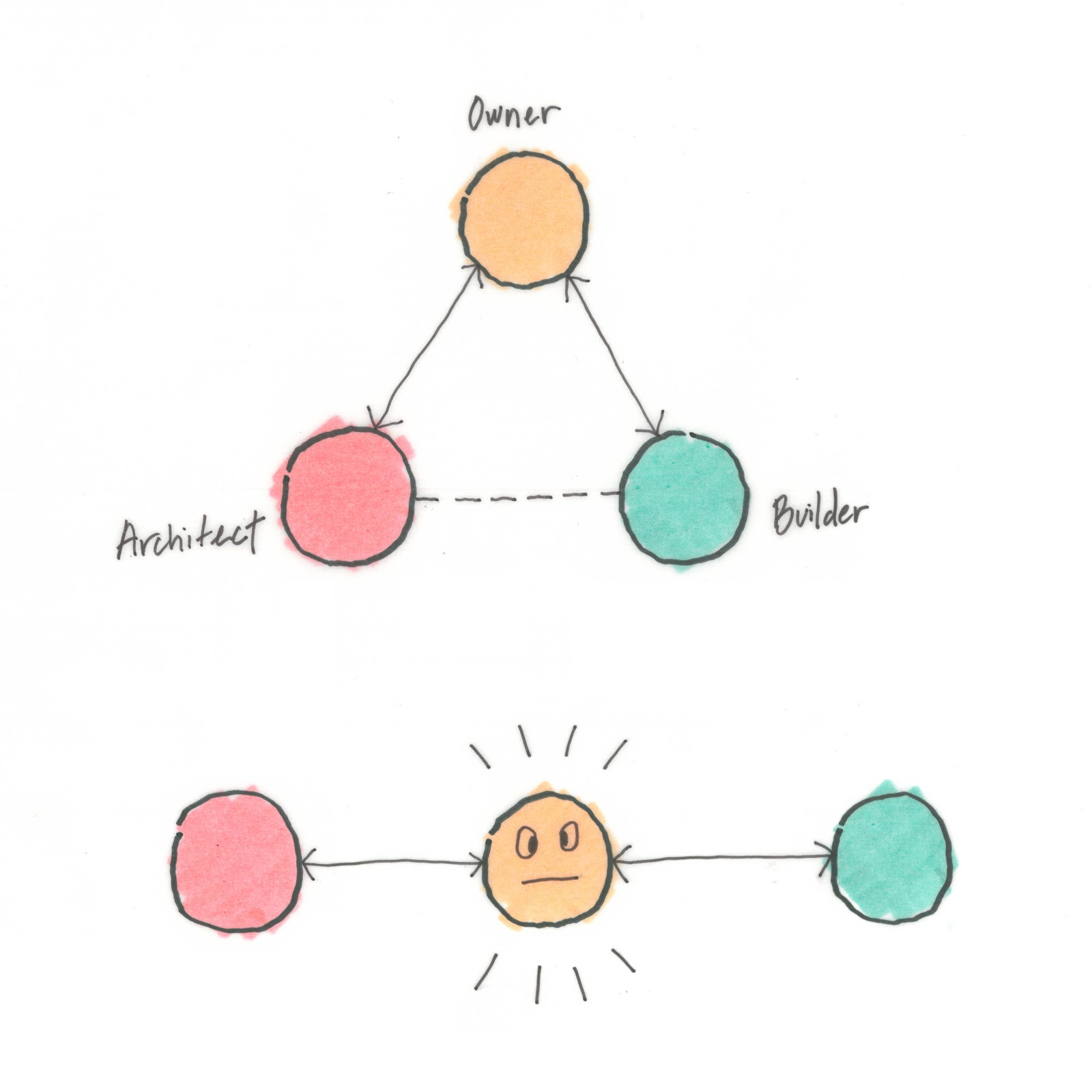
Design Bid Build can make the Owner feel squeezed.
For the first decade of Aamodt / Plumb we operated in this way. We wanted to do things ‘by the book’ and the American Institute of Architects’ “Handbook of Professional Practice” said this is how you do it. It’s a large format, 500+ page hardbound book published by our professional organization and we had it open on our desks during our entire first project. But despite doing everything right we were sued by the builder for doing what the book, and our AIA contract, required us to do.
Let me digress and tell you the story. The design was challenging and the builder was behind schedule. They were feeling the pressure and quit at the end of the job. Our contract with the Owner required that we visit the site and certify that they were indeed no longer working, had removed all of their tools and equipment and therefore were in breach of their contract with the Owner. We did that and later the Builder sued us for tortious interference with their contract. They also sued the Owner, but since they had a contract with the Owner there were provisions for arbitration and mediation. We had no contract with them so they sued us in court, which you can do in the US for almost any reason. Even though we did nothing wrong our insurance company settled with the Builder for an unreasonable sum, which we then paid back in increased premiums. But no one came out unscathed in this process. The Builder almost went broke and the Owner had an incomplete house, legal bills and a lot of headaches.
We soldiered on under the Design Bid Build model for many more years coming to understand very personally many of its disadvantages. My story above illustrates the first disadvantage. Architects and Builders are set in an adversarial relationship. Instead of working together they are working against each other, each one having their own contract with the Owner. Since they don’t have a contract with each other there is no way to set the ground rules of how the relationship will work. And this leads to conflict. Most often the conflict does not end in court but manifests in regular miscommunication, finger pointing, delays, cost overruns and quality issues.
In the Design Bid Build model, Architects and Builders are set in an adversarial relationship.
I also do not believe that the Design Bid Build model leads to the lowest overall project cost. The Owner may have the impression that they are getting the best possible construction cost at the time of bidding but the costs can go up later. The Builder may have missed some of the scope or may be cutting costs by substituting cheaper materials or paying people under the table. They will likely try to make up some of the difference in change orders which could ultimately cost more than the higher bids.
Overall project costs are also higher because the Architect is being paid during construction to monitor the Builder and make sure he is delivering what is designed. Sometimes there is also an additional Owner’s Project Manager that monitors both the Architect and the Builder and this additional oversight costs money. So what seemed like a bargain actually isn’t.
Caveat Emptor! Please don’t try to save money by skipping the Architect’s oversight during construction because you will lose all the value you invested in the design in the first place. I often explain to people that the great looking projects you see on our website are 50% design and 50% follow-through during construction. If we are not there to shepherd the project through during construction then we cannot guarantee these results. Great Builders will also insist on having the Architect involved in this stage because they know it is key to completing a fantastic project.
I often explain to people that the great looking projects you see on our website are 50% design and 50% follow-through during construction.
Many Builders and Architects have recognized the disadvantages that the Design Bid Build model sets up from the outset. In fact I have interviewed many of them for my article “Architects vs Builders” in Custom Builder Magazine. They try to overcome the challenges by forging strong relationships together and by getting the Builder involved very early in the process. This helps a lot with communication and quality but does not fix the underlying contractual hurdles to truly working as a team.
The AIA has also tried to overcome these problems by promoting the Integrated Project Delivery Method whereby the Owner, Architect and Builder jointly form an LLC to complete the project. This may work for large institutions but is overkill for homeowners. As a homeowner myself, I just want to find one entity that can take care of everything and make the process as simple as possible for me, so I can go about the business of living my life. Is that so much to ask?
4. Design Build: Return Of The Master Builder
Enter Design Build. The Owner hires one entity to both design and construct their house. It is just like hiring a Master Builder, aka what an Architect used to be. And shazam, what was old is now new again! I love it when that happens. We don’t need to reinvent the wheel, we just need to rediscover the round one that worked much better than this square one we have got right now.
Architect Led Design Build from GLUCK+ on Vimeo.
After about 10 years of struggling we found this second video from Gluck+ illustrating a better way. So Aamodt / Plumb launched a construction division in 2017 and we have never looked back. Andrew became a licensed contractor and we started offering construction services to our existing clients. When asked if they wanted this new service, their response was an overwhelming “duh?!”
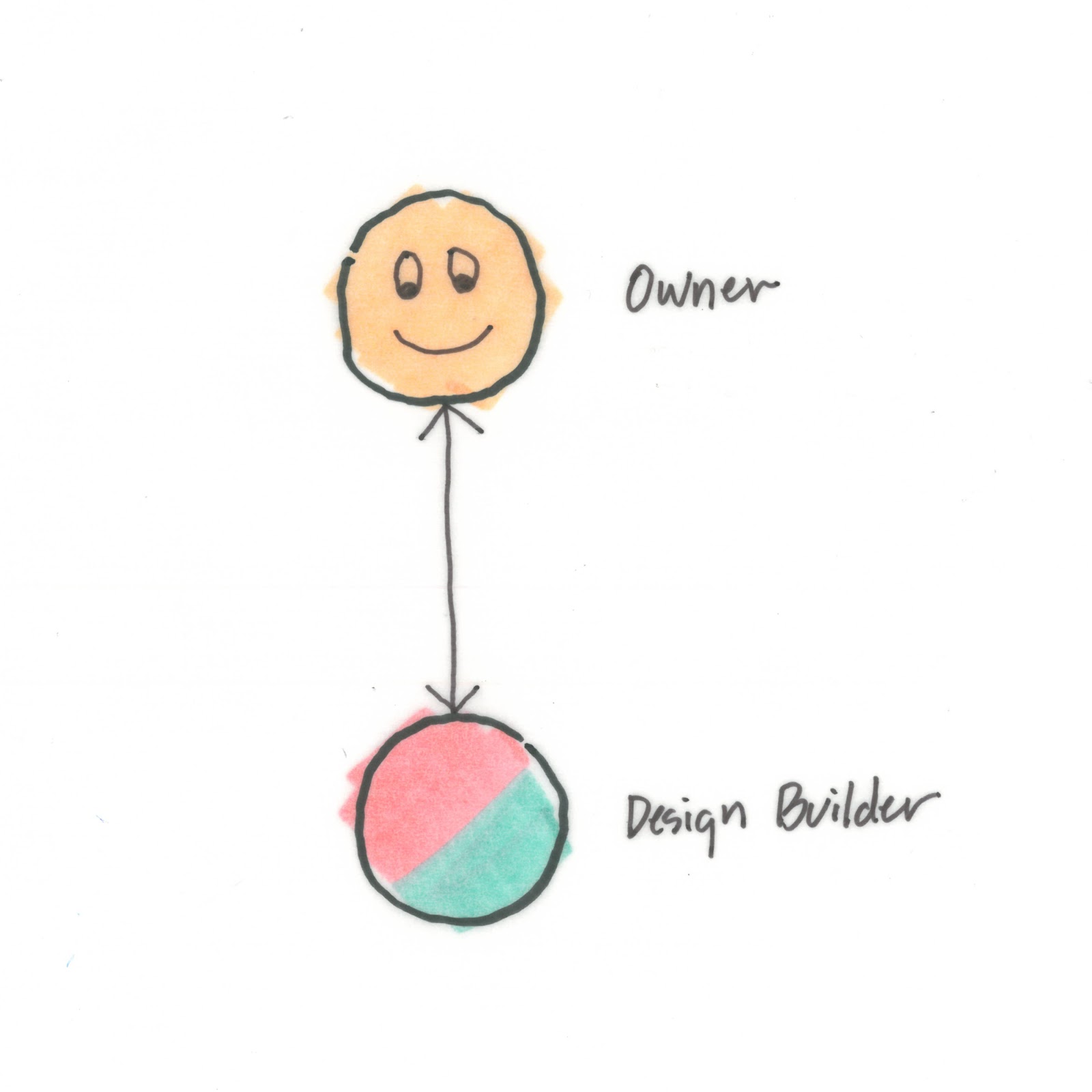
Design Build leaves the Owner feeling more confident about the process.
The biggest advantage for the Owner is having a single source of responsibility. No more communication problems or finger pointing between the Architect and Builder. No more dropped balls or cut corners. And there are several other advantages. With our new construction capabilities we can offer the Owner cost estimating throughout the design process to avoid big surprises later. There is no need to charge Architecture fees to monitor the Builder during construction because we are one and the same. The huge amount of paperwork documenting the flow of information between the Builder and Architect, required in case of future legal conflict, is eliminated and those savings are passed on to the Owner.
Further Reading
5. Two Types Of Design Build Firms
But at this point I would like to make a distinction between two types of Design-Build companies. The vast majority of Design Build firms are led by Builders. They hire in Architects on staff to do the design and drawings necessary to get building permits and build the house. These are not the best designers. Sorry guys, but you know it as well as I do. The Builders don’t charge much, if anything at all, for the design services and as the saying goes “you get what you pay for.” This is a good solution if you want a basic house, but if design is a priority for you then the second type of Design Build firm is better.
There are a few Design Build firms run by Architects and this is where it really gets interesting. On the West Coast it is becoming quite common with great examples like Marmol Radziner. In Europe and Latin America this is also a common model for residential projects. In the Northeast there are only a few Architects doing this and one has been a huge inspiration to us: Gluck+ in New York. They have coined the term Architect Led Design Build. Whereas the Builder Led Design Build is construction with a pinch of design, Architect Led Design Build is a real balance between design and construction – Arkhitekton returns.
Architect Led Design Build offers the best value to the Owner compared with Builder Led Design Build or Design Bid Build. Yes, you will pay for design services, and if you choose a great architect you will get a fantastic house, but you will not overpay by duplicating the efforts of the Architect and Builder during construction. You will also benefit in time and money from streamlined communication and your overall risk will be greatly reduced by having a single point of responsibility.
Architect Led Design Build offers the best value to the Owner compared with Builder Led Design Build or Design Bid Build.
If it is surprising how few Architects have switched to this model then you underestimate the brainwashing that we have gotten throughout most of our careers. Most Architects prefer to stay in their lane and they have been told construction is too risky. Based on the experience we had with our first project, we disagree. We feel more confident about mitigating our risks if we can control the whole process so this makes Architect Led Design Build a win-win for us and the Owner.
6. Advantages Of Architect Led Design Build
- Single-point responsibility
- Greater cost savings and earlier cost certainty
- “Value Engineering” at conceptual stages rather than too late, after project design is complete
- Better communication
- Speed of completion
- Fewer disputes and litigation
- Higher quality outcomes
- Clear roles, responsibilities and accountability
- Less administrative burden
- Reduced risk to the Owner
- Reduced risk to Design Consultants and Subcontractors which results in lower construction costs, greater efficiencies and fewer litigation claims
7. Conclusion
There is nothing new about the Design Build or Architect Led Design Build project delivery approach. In fact that was how buildings were designed and built for thousands of years because it worked really well. There are numerous advantages to the Owner including reduced risk, cost and time, as well as improved quality of the final project. For custom homes this method provides the best value balancing design, cost and quality and should be an important consideration for any Homeowner.
Further Reading
To get a step-by-step overview of the Aamodt / Plumb Architect Led Design Build process you can download this game board (including legend).